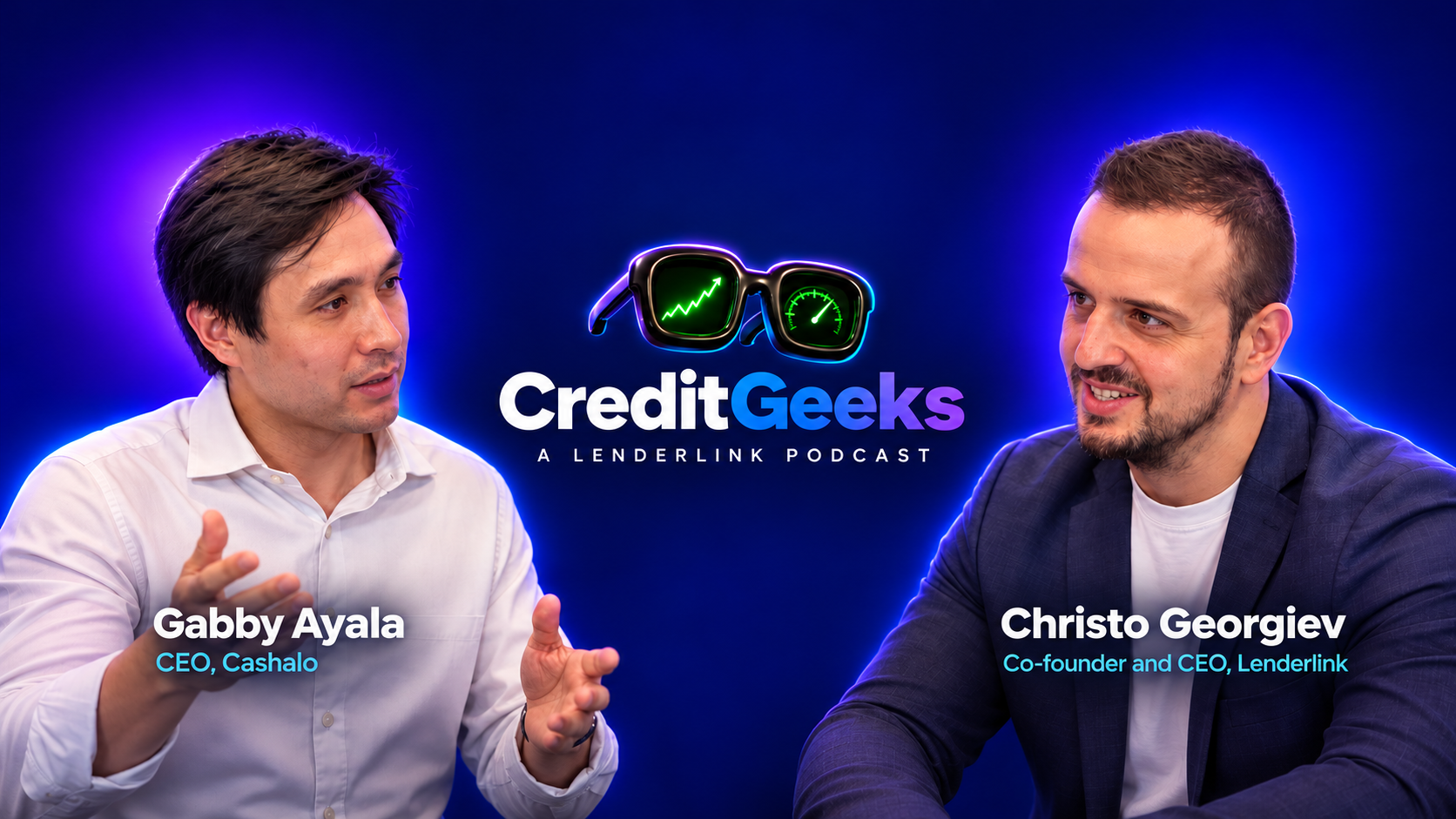
CREDITGEEKS PODCAST · EPISODE 1
Can Philippine lenders reliably tell who a borrower is, what they earn and whether they repay? Not yet, says Gabby Ayala, CEO of Cashalo. This 5-minute read covers the three questions behind every loan, how AI and shared data are closing the gap, and what happened when Gabby played Risky Business.
Many Philippine lenders still make approval decisions without a reliable answer to three basic questions: who the borrower is, what they earn and whether they repay. In Episode 1 of CreditGeeks, Cashalo CEO Gabby Ayala, who spent about a decade in US fintech before coming home, walked LenderLink founder and CEO Christo Georgiev through what that gap costs and how it is starting to close.
What three questions sit behind every loan?
Gabby’s test for any borrower is simple. Are they who they say they are (or, as he joked, Bruce Willis from somewhere else)? Can they afford to repay? And have they shown they will? In the US, a Social Security number, bureau or bank data such as Plaid, and a repayment record answer each one.
In the Philippines, he gives the market about half a point out of three. PhilSys is spreading, but Cashalo still accepts around 11 kinds of ID. There is no open banking and no government database that verifies income. Bureau data leans toward banks, so lenders often build their own history by lending first and watching who pays.
As Gabby put it:
“Lending is about underwriting.”
Christo said the score was closer to zero in 2018 and 2019, so the trend is up, just not fast.
Why is cash the riskiest product to lend?
Gabby came home expecting to meet people who can’t get a loan anywhere. He found that anyone with a phone can usually borrow somewhere, and that cash is the easiest product to run away with, especially when a lender can’t be sure of the borrower’s identity. As Instapay and QR Ph spread, he expects the need for raw cash to shrink, so Cashalo is building credit that isn’t just cash.
Speed adds pressure. Someone facing a medical bill or a power cut can’t wait two weeks for an approval, and many have no payslip to show. That is why Cashalo leans on automation to decide quickly and cheaply.
How is AI changing underwriting?
Cashalo uses machine learning and, increasingly, AI to read far more data than a human underwriter could. Generative AI has widened that data. Chat logs once needed hand-written keyword rules to produce signals. Now an LLM can suggest features, and the team can test whether they predict repayment. Paper records can be scanned and read the same way, which matters where data was never in a structured database.
The results are showing. Gabby says Cashalo has more than halved its NPLs, or non-performing loans, in the past year, and its books look better month over month despite a tougher economy. He rates his own AI use six or seven out of ten and his team’s eight or nine, with one firm rule: if you approve or decline someone, you must know why.
Why do lenders need partners and shared data?
The most valuable data often sits with companies that know the customer but not credit. Even a simple flag, such as a distributor’s list showing who runs a small business, can justify a better offer than the standard consumer rate. Gabby says embedded lending, where a lender offers credit through a partner that already has the customer relationship, and loan channeling are where this heads at scale, with both sides sharing the profit.
The same logic applies between lenders. A borrower who looks healthy on your books may be struggling elsewhere, and the reverse is true too. Gabby put it bluntly:
“Holding on to data kind of signals to me that you don’t think that you can underwrite better than other people.”
Borrowers pay for that attitude, he argued, because a lender with no priors prices in the risk with high rates. He is realistic that nobody shares data out of kindness, so contributors need something back, such as insight into the wider market. He volunteered to be the first customer for LenderLink’s portfolio benchmarking.
What did the rate cap change?
A lower rate cap came in February and the moratorium on new online lenders has lifted. Gabby welcomes the competition, with a caveat: he wants to win with a better product, not because a rule blocks others. He doesn’t think caps fix high prices, since missing infrastructure does. Still, the cap has helped Cashalo, because borrowers now compare rates and lenders who covered weak underwriting with high pricing lose their cushion.
His advice to borrowers: check the price against competitors, and look at the amount you actually receive, since fees can be deducted. His ask of regulators: new entrants should report to the CIC.
Bonus round: Can Gabby Ayala approve good borrowers?
Risky Business is BidaCredit’s game that puts you in the underwriter’s chair: approve, reject or ask for more information. Gabby’s first question was whether there is a prize. Christo hoped there was cake.
Round one was a government hospital nurse, six years on the job, asking for ₱50,000 over 18 months. Her payslip and payroll credits confirmed her income, her repayment record was strong and her identity matched. Gabby approved, and in the simulation she repaid every installment.
Round two was harder: a gig worker wanting a 24-month motorcycle loan, with no CIC record, no LenderLink record and 15 data points to weigh. Gabby admitted a bias, since he once worked on electric motorbikes for TNVS drivers, where owning the battery as the asset brings the price down from roughly ₱120,000 to ₱70,000 to ₱80,000. Setting that aside, he read the clues. A PhilSys ID answered the identity question. A location trail from Cavite to Alabang to Makati six days a week suggested the applicant was really working. A telco score of 7 out of 10 stood in for the missing borrowing history. He approved, and he was right.
Real life is messier, he added: Cashalo looks at tens of thousands of other signals, including whether a device shares an IP address with known fraudsters. Both cases carried one lesson, though. Having no history is not a red flag on its own. On new-to-credit borrowers, Gabby said:
“It’s not that they don’t want to repay. It’s just they’re not used to having stringency on the loan.”
In his view, they are usually an education problem, not a risk problem. They are used to borrowing from friends, where a few days late is forgiven.
What does Gabby expect by 2031?
Christo gave Gabby an imaginary crystal ball and asked for one prediction. Gabby went contrarian: it is not a foregone conclusion that GCash is still the country’s top downloaded financial app. With identity, bureau data and collaboration improving, he expects what happened in the US, where fintechs used alternative data to challenge the big banks. Christo is just as bullish that the future is more nuanced than today’s picture.
Where does LenderLink fit?
LenderLink is the Philippines’ first credit data exchange, a network of lending institutions that share fresher data with a borrower’s consent. A lender checks the borrower in under a second before lending and gets an alert if their activity changes afterward. Gabby said LenderLink data has been one of the best sources Cashalo has tested, and LenderLink publishes a borrower report twice a year, with portfolio benchmarking planned for next year.
If you want to see how this could support your approvals, collections and fraud prevention, visit lenderlink.ph to learn more.
What does this look like in a nutshell?
Here’s Episode 1 as a quick visual.
🔍 The gap
Lenders need to know who a borrower is, whether they can pay and whether they will. The Philippines scores about half a point out of three.
⚙️ The shift
Cashalo pairs machine learning and AI with partners and shared data, and has more than halved its NPLs in a year.
🎮 The test
In Risky Business, Gabby approved a nurse and a gig worker by matching each signal to one of the three questions.
🌱 The upside
New to credit isn’t the same as risky. With education and shared data, more borrowers get a fair first loan, and lenders can price risk lower.
Key takeaway: The loan is the easy part. Knowing who you’re lending to is the work.
Hear the full episode
Watch or listen to Episode 1, then see if you can beat the CEO of Cashalo at Risky Business. Subscribe and follow LenderLink on social media for more episodes, and guess who the next CreditGeek will be.